
Sherry Butts vs Hogsheads: A Volume-First Lens on Highland Cask Allocation
In any maturing asset class, the discipline that separates serious capital from sentiment is the willingness to strip out the romance and look at the mechanics. Scottish whisky casks now trade as part of structured alternative allocations across Singapore, Hong Kong, London and Sydney. That means evaluating them the way you would any inventory-based asset: by capacity, attrition, carrying cost, and liquidity at exit.
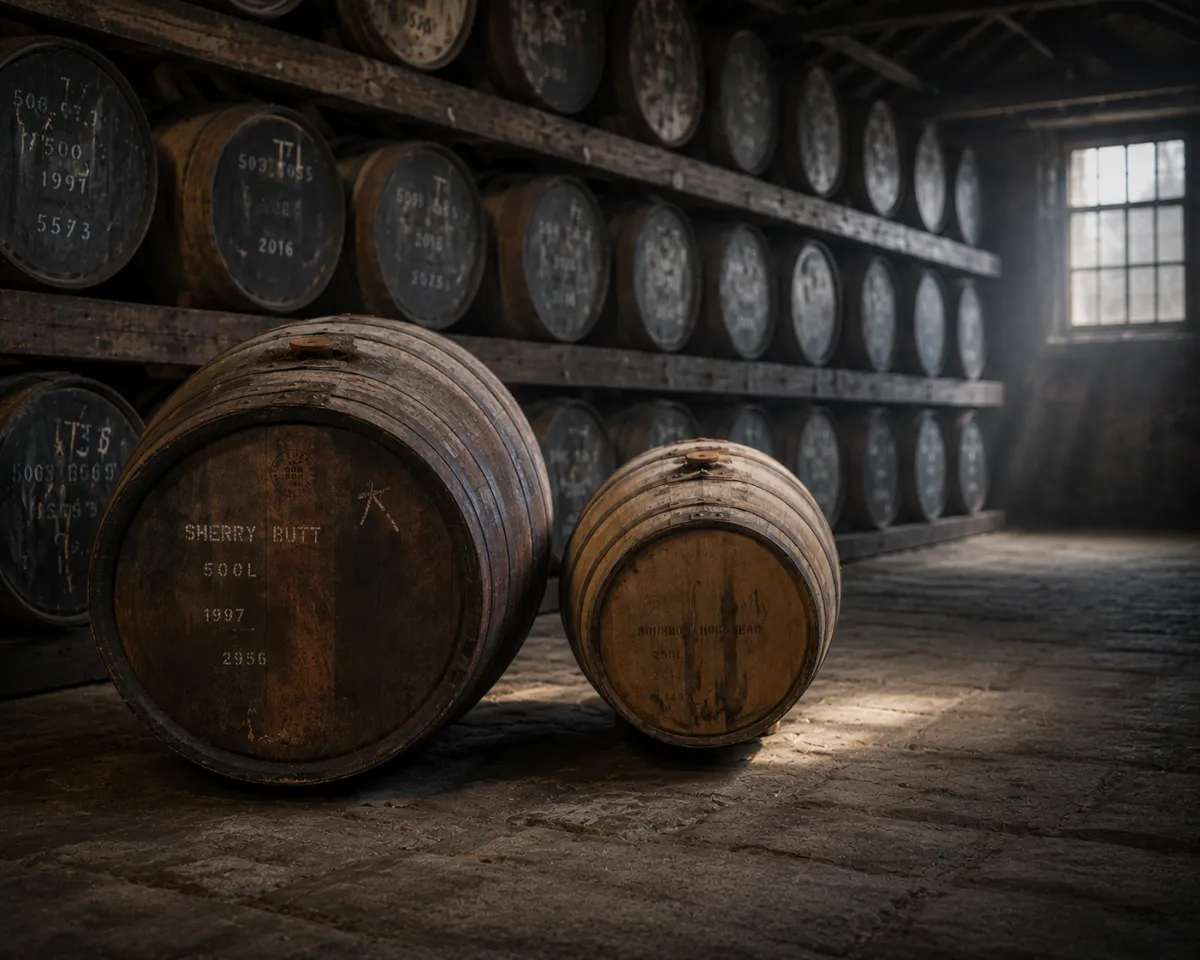
Two formats dominate trade at the Highland and Speyside level. The sherry butt, with a nominal capacity of around 475 to 500 litres. The hogshead, sitting closer to 225 to 250 litres. They are not interchangeable in a portfolio. The current Whisky Cask Club inventory, with more than 450 actively traded casks across Highland, Speyside and Islay, makes the contrast plain.
Capacity sets the ceiling
A sherry butt in our current book holds an average of around 265 litres of residual alcohol at a median maturation of 13 years. A 250-litre hogshead at almost identical median age sits at around 130 LOA. That ratio, roughly 2 to 1, is the single most important number in this comparison. Every downstream economic decision flows from it.
In bottle-line terms, that sherry butt yields close to 950 standard 70cl bottles at 40 percent ABV, or roughly 700 to 800 at typical cask strength. A hogshead delivers around half. For investors thinking in terms of exit economics, the format chosen at acquisition fundamentally caps what the asset can do.
Ex-bourbon barrels, the smallest workhorse format at 200 litres nominal, average around 120 LOA at a median age of nine years. They are the highest-turnover format in the trade and the entry point for most first-time allocators.
Angel's share is not uniform
The conventional claim that all cask formats lose around 2 percent per year is geometrically incorrect. Smaller casks have a higher surface-to-volume ratio of liquid in contact with wood, which raises annual evaporation. At Whisky Cask Club we work to a baseline of approximately 1.5 percent annual angel's share for sherry butts and 2 percent for ex-bourbon barrels, with hogsheads sitting closer to the bourbon figure.
That seemingly small differential compounds. A 1969 Longmorn sherry butt, after more than half a century of maturation, retains around 50 LPA. A 1969 Glenrothes sherry hogshead, identical vintage, has attrited to around 35 LPA. The butt has lost meaningful volume, but it remains a commercially bottle-able asset. The hogshead is moving toward the floor at which an independent bottler can extract a viable release.
Closer to a working investment horizon, a 1996 Springbank fresh sherry butt at 29 years carries around 205 LPA, while a 1997 Springbank sherry hogshead, near-identical vintage, holds closer to 60.
Cost efficiency favours the larger format
Insurance and rent at typical bonded warehouse rates are charged per cask, not per litre. Spread a fixed annual carrying cost across roughly 265 litres of alcohol versus 130, and the sherry butt comes in at less than half the unit holding cost of the hogshead. Over a 12 to 15 year holding period, that gap becomes a material drag on the return of a hogshead-weighted book.
Where hogsheads earn their place
Our inventory is currently weighted to hogsheads and barrels by a wide margin, with roughly four barrels and three hogsheads on the book for every sherry butt. The market clears more hogsheads because they suit a wider range of buyers. Independent bottlers needing flexibility in release sizes. Private buyers preferring a single-cask bottling at manageable volume. Tactical allocators looking for shorter holding cycles. Greater wood contact per litre also accelerates maturation, which suits investors targeting an exit at 8 to 12 years rather than 15 to 25.
The Macallan inventory is illustrative. Of the Macallan casks currently on our book, the overwhelming majority are hogsheads, predominantly Pedro Ximenez and oloroso seasoned. Sherry butts in Macallan are scarce, and that scarcity itself is part of the case for holding one when the opportunity arises.
Portfolio construction, not either-or
The right answer for most allocators is to hold both. Sherry butts anchor the long-dated, capital-efficient core where retention of alcohol mass and lower unit carrying cost compound over 15 plus years. Hogsheads and ex-bourbon barrels provide tactical exposure, faster maturation cycles, and a broader pool of exit buyers. A handful of Highland distilleries on our book currently offer both formats, including Ardmore, Ben Nevis, Dalmore, Glen Ord and Royal Brackla, allowing both sides of that barbell to be sized at a single distillery.
What I would not recommend is allocating to either format without an explicit view on holding period and exit route. The format chosen at entry determines what exit options remain open in year 12, year 18, or year 25. That decision is made on day one, and is best made with inventory data in front of you, not the marketing copy.
By Alexander Knight


